The Proposed Bullet Train Routes in India

*Map showing the proposed bullet train routes in India


HIGH-SPEED CORRIDORROUTESTATIONSSPEEDLENGTH (KM)FURTHER EXTENSIONSTATUS
East India
Howrah - Haldia High-Speed Passenger CorridorHowrah-HaldiaTBD250-300135TBDApproved by Planning Commission & PMO
North India
Delhi - Patna High-Speed Passenger CorridorDelhi-Agra-Kanpur-Lucknow-Varanasi-PatnaTBD200 - 350991HowrahApproved by Planning Commission & PMO
Delhi - Amritsar High-Speed Passenger CorridorDelhi-Chandigarh-AmritsarTBD450TBDApproved by Planning Commission & PMO
Delhi - Jodhpur High-Speed Passenger CorridorDelhi-Jaipur-Ajmer-JodhpurTBD591TBDProposed
South India
Chennai - Bangalore - Trivandrum HSRChennai-Bangalore-TrivandrumTBD350649Approved by Planning Commission & PMO
Hyderabad - Chennai High-Speed Passenger CorridorHyderabad-Dornakal-Vijayawada-ChennaiTBD664Howrah
(ViaVisakhapatnam)
Approved by Planning Commission & PMO
Thiruvananthapuram - Mangalore High-Speed Passenger CorridorThiruvananthapuram - Mangalore9300585UdupiApproved by Planning Commission & PMO
Bangalore - Mysore High-Speed Passenger CorridorBangalore - MysoreTBD350110Not plannedProposed
West India
Ahmedabad - Dwarka High-Speed Passenger CorridorAhmedabad - Rajkot - Jamnagar - DwarkaTBDTBD
Mumbai/Navi Mumbai - Nagpur High-Speed Passenger CorridorMumbai/Navi Mumbai - Nashik - Akola -NagpurTBATBAProposed
Pune - Mumbai - Ahmedabad High-Speed Passenger CorridorPune-Mumbai-Ahmedabad7300 - 350650BangaloreApproved by Planning Commission & PMO
Rajkot - Veraval High-Speed Passenger CorridorRajkot - Junagadh - VeravalTBD350TBD

Bullet train on track, work to start in 2017

The trains could be running between Ahmedabad and Mumbai at 320
Work on the ambitious Rs1 lakh crore Ahmedabad-Mumbai Bullet train project, the country's first high-speed rail corridor, seems to be picking up speed. The groundbreaking ceremony of the project, which involves construction of a 505-km line using Japan's Shinkansen technology, and was first proposed way back in 2004, is expected in the current year itself.
A recent report in Nikkei Asian Review said that the Indian government has brought forward the groundbreaking ceremony to within 2017. The report said that trains could be running between the two cities at a speed of 320 km per hour by 2023.
The Nikkei report said that detailed design study for the high-speed project has formally begun. On completion, the Bullet train will reduce the travel time between Ahmedabad and Mumbai from the current eight hours to just over two hours.
A senior Gujarat government official confirmed that there is a lot of movement related to the Bullet train project of late.
"The project's construction work is expected to start in 2018 and is estimated to be completed in five years," he said.
The timeline for starting work and making the Bullet train operational may not be coincidental, as the next Lok Sabha elections will take place in 2019 and the one after that in 2024.
Chief secretary JN Singh said that the Gujarat government holds 25% equity in the ambitious project, but primary execution of the project is being done by the railways.
The cost of the Bullet train project was originally estimated at close to Rs98,000 crore, of which the Japan International Cooperation Agency (JICA) would fund 81% or nearly Rs80,000 crore. The remaining funds would be contributed by Indian Railways, and the governments of Gujarat and Maharashtra.
Minister of state for railways Rajen Gohain said in the Parliament recently that the cost of the corridor is expected to go up by about Rs10,000 crore due to the decision to construct it as a fully elevated project. The decision is aimed at enhancing safety and reducing land requirement for the project.
The terminal in Ahmedabad is planned to come up at the existing Sabarmati railway station, while in Mumbai, the plan is to build it under the Bandra Kurla Complex.
An engineering marvel
The Bullet train project, which is expected to revolutionise country's transportation infrastructure, will be an engineering marvel. Even as the government is mulling the entire project to be an elevated one, around 7 km stretch of the line between Virar in Mumbai and Thane will pass under the sea. This will be the country's first undersea tunnel.
As per feasibility studies, the line will have 12 stations between Ahmedabad and Mumbai. The trains will make halts at Surat and Vadodara. The travel time between the two cities will come down to two hours and seven minutes, which is almost one-fourth of the current travel time.
The planned fare for the route will be around Rs3,300, one-and-a-half times the price of a AC class I ticket currently. It is expected to carry about 35,800 passengers a day initially.
The trains will run on the same 1,435 mm track gauge as Japan's Shinkansen bullet trains.

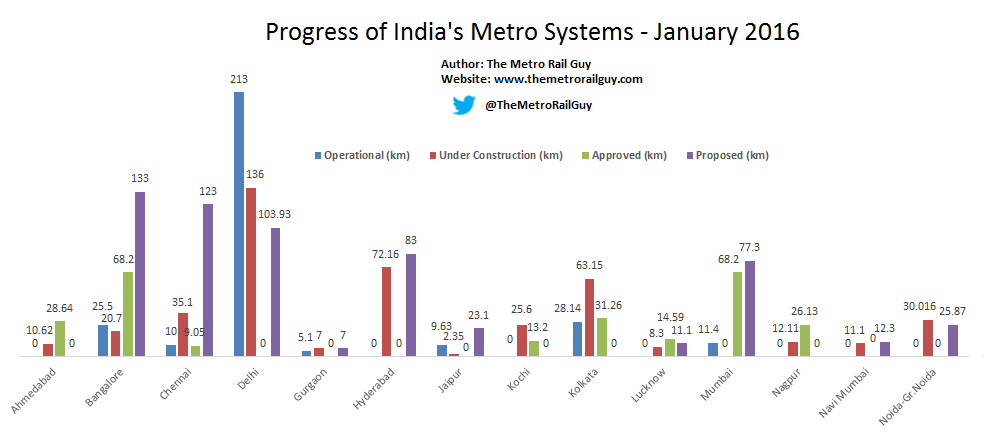
Snapshot of How India’s Metro Systems Stack Up With One Another

Snapshot of How India’s Metro Systems Stack Up With One Another

link to previous chart: January 2016
Note:
• In the interest of space, only under construction projects have been included above. Besides the above cities, metro projects have been approved by different state governments’ cabinets in Pune, Indore, Bhopal, Kanpur, Varanasi, Patna, Guwahati, Vijayawada – Amravati, Kozhikode and Trivandrum.
• Under Construction includes those section of lines for which contracts have been awarded and machinery/men have been mobilized on-site. For instance, a 10.39 km section, from Lokmanya Nagar to Jhansi Rani Square, in Nagpur for which piling work started in December 2016 has been included. On the other hand, sections of Kolkata’s metro lines which have been awarded for construction years ago, but have seen no ground-work, have been allocated to the approved column.
• Approved includes sections of lines which have at least been approved by the state government’s cabinet.
• Proposed includes upcoming lines which have been announced by the state government or local development agency. Their routes & distance are likely to be revised by the time their Detailed Project Report is created and approved. For instance, Delhi’s 140 km proposed figure includes the 105.93 km Phase 4 project (within Delhi) as well as other lines proposed by the Haryana and UP governments in Gurgaon and Ghaziabad. Bangalore’s 102 km figure includes the 17 km SilkBoard – KR Puram line (Phase 2A) as well as the Phase 3 project.
• The ‘Delhi’ label includes the entire Delhi Metro network which extends beyond Delhi’s borders into Ghaziabad, Noida, Faridabad & Gurgaon. The ‘Gurgaon’ label includes the line operated by Rapid Metro Rail Gurgaon (RMRG) while ‘Noida’ includes the line being implemented by the Noida Metro Rail Corporation (NMRC).

Hyderabad Metro

Hyderabad Metro – Information, Map & Updates


Introduction
The Hyderabad Metro Rail (HMR) system is an urban Mass Rapid Transit System (MRTS) that is being built to serve Hyderabad, the capital of Telangana. Construction for its 72 km first phase on the Public-Private Partnership (PPP) model started in April 2012 by L&T Metrorail and is expected to be completed in 2019 (est.). Although Phase 2’s new lines & extensions have been announced, it is likely to be modified by the time construction begins in 2019.

Key Figures

Operational: 0 km | Under Construction: 66 km | Approved: 6 km | Proposed: 83 km
Currently the 72 km Phase 1 is under construction of which the Nagole – Mettuguda (8 km) section of the Red line and the Miyapur – SR Nagar (10 km) section of the Green line are expected to open in 2017-2018 as soon as the state government & L&T agree to start operations. Phase 2 is currently in the planning stage..

Future Network: Phase 1-2

The embedded maps below can be zoomed into!
Key for map below: Phase 1 (Under Construction) | Phase 2  (Planned) 

Kochi Metro

Kochi Metro – Information, Map & Updates

Introduction
The Kochi Metro system is an urban Mass Rapid Transit System (MRTS) that is being built to serve Kochi, the commercial capital of Kerala. Construction for its 25.12 km Phase 1A from Aluva to Pettah with 22 stations started in June 2013. On June 17, the Prime Minister of India inagurated a 13.2 km section, from Aluva to Palarivattom, and commercial operations commenced 2 days later on June 19.
In 2014, a 1.92 km eastward extension to Tripunithura from Pettah was approved to be included in Phase 1. Construction on it will begin once road widening along the route is completed. Phase 1B of the project includes a new spur line from Jawaharlal Nehru Stadium to Infopark II in Kakkanad. The project was approved by the state government in May 2015 and construction work is expected to begin in 2017.
Various announcements of what Phase 2 will look like have been made, but detailed planning for it is yet to begin.

Key Figures

Operational: 13.2 km | Under Construction: 12.412 km | Approved: 1.92 km (Phase 1) and 11.2 (Phase 1B)
Phase 1A: Aluva – Tripunithura:  27.04 km, 24 stations (operational & under construction)
Phase 1B: JLN Stadium – Infopark II: 11.2 km, 10 stations (approved)
The embedded maps below can be zoomed into!

Operational Network:

Future Network: Phase 1A & 1B

Stations on Line 1:
Phase 1A: 
Aluva, Pulinchodu, Companypady, Ambattukavu, Muttom, Kalamassery, Cochin University (CUSAT), Pathadipalam, Edapally, Changampuzha Park, Palarivatom, JLN Stadium, Kaloor, Lissie, M.G. Road, Maharaja’s College, Ernakulam south, Kadavanthra, Elamkulam, Vytila, Thykkoodam, Pettah, SN Junction & Tripunithura
Phase 1B: Palarivattom Bypass, Chembumukku, Vazhakkala, Kunnumpuram, Kakkanad Junction, Kochi SEZ, Chittethukara, Rajagiri, InfoPark I, and InfoPark II

List of Major Contractors

ContractDetailsContractor
GCGeneral ConsultantDMRC
DDCDetailed Design ConsultantEgis India
KRS-175 Coaches (Rolling Stock) & Signalling SystemAlstom India
KS-1Signalling, Train Control & TelecommunicationAlstom India
KS-2Automatic Fare CollectionAxis Bank
KC-02Construction of viaduct & 6 stations from Aluva – KalamasseryLarsen & Toubro
KC-03Construction of viaduct & 6 stations from CUSAT – JLN StadiumLarsen & Toubro
KC-04Construction of viaduct & 5 stations from Kaloor – Ernakulum SouthSoma Enterprise
KC-05Construction of viaduct & 5 stations from Kadavanthara – PettaEra-Ranken JV
KC-11Construction of Muttom DepotMcNally Bharat

History – Key Dates

19 June 2017: Aluva – Palarivattom (Line-1) – 13.2 km

Mumbai Metro

Mumbai Metro – Information, Map & Updates

Introduction

The Mumbai Metro system is an urban Mass Rapid Transit System (MRTS) serving Maharashtra’s capital. Its development has been entrusted to the Mumbai Metropolitan Region Development Authority (MMRDA), who in 2004 came out with a 146.5 km master plan with multiple lines. Due to various issues which range from policy paralysis to environmental issues, the MMRDA has so far only been able to implement 1 metro line to connect Versova in the western suburbs with Ghatkopar in the eastern suburbs. In 2015, a new 118 km master plan was approved and the new government has provided much needed impetus for the development of 2 lines (Dahisar E – Andheri E & Dahisar – D.N. Nagar) in addition to the upcoming Colaba-SEEPZ line.

Key Figures

Operational: 11.4 km | Under Construction: 68.2 km | Approved: 55.82 km | Proposed: 38.5 km
Note: The MMRDA has not fixed line colors yet.
Operational• Line-1: Versova – Andheri – Ghatkopar – 11.4 km
Executed & operated by a JV of Reliance Infra (69%), MMRDA (26%) & Veolia Transport (5%)
Stations: Versova, D.N. Nagar, Azad Nagar, Andheri, Western Express Highway (WEH), Chakala, Airport Road, Marol Naka, Saki Naka, Asalpha, Jagruti Nagar, Ghatkopar
Under Construction• Line-2A: Dahisar (E) – D.N. Nagar – 18.6 km
This line is part of the larger 40 km line between Dahisar & Mankhurd
Line 2B will link DN Nagar with Mankhurd (23.5 km)
• Line 3: Colaba – BKC – SEEPZ –  33.5 km
To be executed & operated by Mumbai Metro Rail Corporation Ltd – GOI (50%) & GoMH (50%)
• Line-7: Dahisar (E) – Andheri (E) – 16.5 km
In the future, this line will be extended to Mira-Bhayander in the north (Line-9) and to CSI Airport’s Terminal-1 & further to Bandra (E) in the south (Line-10)
To be executed by the Mumbai Metropolitan Region Development Authority
Approved• Line-2B: D.N. Nagar – Mankhurd – 23.5 km
This line is part of the larger 40 km line between Dahisar & Mankhurd
• Line-4: Wadala – Ghatkopar – Thane – Kasarvadavali – 32.32 km
To be executed by the Mumbai Metropolitan Region Development Authority
In the future, this line is expected to be extended to the GPO (CST) & possibly onward to Apollo Bunder in South Mumbai as part of Line-8
Proposed (not yet approved by State Government)
• Line-5: Thane – Bhiwandi – Kalyan – 24 km
• Line-6: Lokhandwala – Jogeshwari – Kanjurmarg – 14.5 km
To be executed by the Mumbai Metro Rail Corporation Ltd

Operational Network

The embedded maps below can be zoomed into!

Future Network:

History – Key Dates

08 June 2014: Versova – Andheri – Ghatkopar (Line-1) – 11.4 km
…..more to be added in 2020! Click on ‘Construction Updates’ below to view updates.

Bangalore Metro

Introduction
The Bangalore (Namma) Metro system is an urban Mass Rapid Transit System (MRTS) serving Bengaluru – Karnataka’s capital. Construction for the first 42.30 km phase started in April 2007 and its first section, connecting Baiyyappanahalli – MG Road on the Purple Line, opened in 2011. The 6th (final) section was inaugurated by the President on June 17 2017 and commercial operations started on the next day.
Construction work on the 72 km Phase 2’s first new section (Mysore Road – Pattanagere, Reach-2A of Purple Line) started in September 2015 (See: Construction Updates). The project faced funding issues due to which a majority of civil construction contracts were awarded only in the first half of 2017. While the Purple Line’s extension to Challeghata & Green Line’s extension to Anjanapura Township will be ready in 2020, the entire phase, including a 13.9 km underground section, is expected to be ready only by 2024 after which the metro network will become 114.4 km long.
A 102 km Phase 3 is currently on the drawing board of which 18 km (Central Silk Board – KR Puram) has been expedited and will be built in parallel with Phase 2 under Phase 2A.

Key Figures

Operational: 42.30 km | Under Construction: 46.195 km | Approved: 44.761 km | Proposed: 85 km

Operational Network

The embedded maps below can be zoomed into!

Future Network: Phase 1-2

Key for map below: Phase 1 | Phase 2

History – Key Dates

Phase 1
20 Oct 2011: Baiyyappanahalli – MG Road (Purple line) – 6.7 km
01 Mar 2014: Sampige Road – Peenya Industry (Green line) – 9.9 km
01 May 2015: Peenya Industry – Nagasandra (Green line) – 2.5 km
16 Nov 2015: Mysore Road – Magadi Road (Purple line) – 6.4 km
30 Apr 2016: MG Road – Magadi Road (Purple line) – 4.8 km
19 June 2017: Sampige Road – Yelachenahalli (Green line) – 12 km

Chennai Metro MAP


Delhi Metro Map

Delhi Metro Map

The Delhi Metro is a state owned company with equal equity participation from Government of India and Government of National Capital Territory of Delhi. However, the organisation is under administrative control of Ministry of Urban Development, Government of India. Delhi Metro is a rapid transit system serving Delhi, Gurgaon, Noida, and Ghaziabad in the National Capital Region of India. Delhi Metro is India's first modern public transportation system,which has revolutionized travel by providing a fast, reliable, safe, and comfortable means of transport

Guidelines For Indian Passport Holders

One of the most important documents that every Indian citizen will need to procure is a passport. This document serves not just as a proof of identity and address, but also allows holders to travel across the world under the protection of the Indian Government. Indian citizens can procure a passport both online or offline, by visiting the Passport Seva Kendra’s website or office, respectively.
In order to avail a passport, applicants will have to fill in the required forms, submit necessary identity and address proof and select a date for the appointment. On the required date, they must visit the Passport Seva Kendra at the appointed time, wherein their documents will be verified. After the necessary procedures and verification is complete, applicants will receive their passport by post.
Given below are some of the guidelines that should be kept in mind, by those who wish to avail an Indian passport.
  • The Indian passport is a very important document and should remain in the personal custody of the passport holder, at all times. If not in personal custody, then a person who has been duly authorized by the holder will have to keep it their custody.
  • Individuals are not allowed to send their passport out of India, by post.
  • A passport is the only document that identifies the holder as an Indian citizen, in a foreign country.
  • The passport is also a travel document, in addition to being a document of identification. Individuals cannot enter or leave India without their up-to-date passport.
  • Individuals will have to ensure that their passport is always up-to-date and is valid. A passport can be renewed for up to a year prior to its expiry.
  • In case an individual loses his/her passport, misplaces it or if the passport is destroyed or stolen, a report must be immediately filed at the closest police station, with an authority issuing passport as well as the closest Indian mission abroad.
  • Apart from maintaining the original passport carefully, individuals will have to ensure that they maintain a photocopy of their passport. This will be useful, in case this document is stolen or misplaced.
  • Applicants should note that they can be refused passport related facilities on the following grounds -
    • Suppression of facts and information
    • Providing information that is not true
    • Wilful damage of passport
    • Changing details in the passport, without authorization
    • Tampering with information provided in the passport, without authorization
  • In case an individual acquires the citizenship of another country, they will not be a citizen of India any longer. They will have to immediately get their Indian passport cancelled and the cancelled passport should be maintained carefully, if needed in the future.
  • Provision of Indian passports Act of 1967 will be violated, in case the following acts are committed
    • Travelling without valid passport
    • Providing wrong information on the passport application form, on purpose
    • Attempting to change entries in the passport
    • Not providing passport for inspection
    • Using a travel document or passport that is owned by someone else, on purpose
    • Allowing another individual to use the holder’s passport or travel document, on purpose
    • Holding over one valid passport at a given point of time
Any of the actions above can result in the individual getting imprisoned for a period of 2 years or fine, or both. Additionally, the individual’s passport can also be revoked by the Indian authority.
  • In case the applicant is not a citizen of India, yet applies for a passport by withholding information regarding their nationality, or if the individual has a forged passport, they can be imprisoned for a period of 5 years along with a fine.
  • Consular services will not be provided to refugees or dependents or others, if they have left India illegally.

Indian Passport Fees/Costs

The cost of a passport depends on the type of passport service applied for and whether it is on a regular basis or Tatkaal.
For regular or Normal Passport applications the fees are as follows:
Type of Passport36 pages booklet60 pages booklet
New or fresh passport(Validity - 10 years)Rs.1,500Rs.2,000
Renewal of passport (Validity - 10 years)Rs.1,500Rs.2,000
Adding a booklet when the pages in the existing passport are exhausted or all used up(Validity - 10 years)Rs.1,500Rs.2,000
Minors aged 15 to 18 years - new/fresh/renewal/reissue of passport - validity 10 yearsRs.1,500Rs.2,000
Minors - new/fresh/renewal/reissue of passport - validity 5 years or until attaining majorityRs.1,000
Duplicate or replacement of lost/stolen/ misplaced/damaged existing passportRs.3,000Rs.3,500
Duplicate or replacement of passport for updating or modification of certain details viz. removal of ECR Status or changing personal details(validity 10 years)Rs.1,500Rs.2,000
Minors - Duplicate or replacement of passport for updating or modification of certain details viz. removal of ECR status or changing personal details(validity 5 years or till they attain majority)
For Tatkaal passport applications
Passport fees for urgent applications will be charged at Rs.2,000 in addition to the regular fees mentioned above. This makes the tatkaal passport cost / fee structure -
Type of Passport36 pages booklet60 pages booklet
New or fresh passport(Validity - 10 years)Rs.3,500Rs.4,000
Renewal or reissue of passport(Validity - 10 years)Rs.3,500Rs.4,000
Adding a booklet when the pages in the existing passport are exhausted or all used up(Validity - 10 years)Rs.3,500Rs.4,000
Minors aged 15 to 18 years - new/fresh/renewal/reissue of passport - validity 10 yearsRs.3,500Rs.4,000
Minors - new/fresh/renewal/reissue of passport - validity 5 years or until attaining majorityRs.3,000
Duplicate or replacement of lost/stolen/ misplaced/damaged existing passportRs.5,000Rs.5,500
Duplicate or replacement of passport for updating or modification of certain details viz. removal of ECR status or changing personal details(validity 10 years)(fresh booklet)Rs.3,500Rs.4,000
Minors - Duplicate or replacement of passport for updating or modification of certain details viz. removal of ECR status or changing personal details(validity 5 years or till they attain majority)(fresh booklet)Rs.3,000
For PCC - Police Clearance Certificate cost/fee - Rs.500
For Diplomatic or Official Passports - No fee/cost applicable

How to Pay the Passport Fee

Online Payment:
  • Applicants can pay the required fees online through:
      • Credit / Debit Card.
      • Internet Banking through State Bank of India and Associate Banks.
    • Online payments are mandatory for appointment bookings at PSKs.
    • While making online payment for applications under the Tatkaal scheme, applicants need only pay the fee applicable under the normal scheme category, and the remaining Tatkaal fee should be paid in cash.
    • For debit / credit cards, banks charge 1.5% + Service Tax as applicable on every transaction. This does not apply for SBI and Associate Banks.
    • Online payment remains valid for one year from the first appointment date and applications must be submitted within this time. If not, the payment will be considered forfeited, and a new payment will have to be made.
    • At Citizen Service Centres (CSCs), payment can be made by credit / debit card.
  • Cash Payment:
    • Payments can be made in cash at any of the Passport Seva Kendras (PSKs)
    • For Tatkaal applications, the entire application amount of the normal application fee plus Tatkaal fee can be paid in one go, unlike online payments for Tatkaal applications.
    • While dealing with cash at the PSK, the public is warned to beware of touts and agents.
    • At PSKs (Passport Seva Kendras), payment for passport will have to be made In Cash only. This applies to mini-PSKs too. All PSKs host ATMs for all banks so cash withdrawal to make payment is made easier.
  • Demand Draft:
    • At District Passport Cells (DPCs), payment will have to be made via DD (Demand Draft).
    • The DD has to be made out to PAO-MEA to be satisfied at the RPO.
    • At Speed Post Centres (SPCs), payment can be made via DD (Demand Draft) or Cash. The DD must be drawn in favour of PAO-MEA and will be payable where the RPO is located.
It should be noted that:
  1. The following details must be written behind the DD:
    • Applicants name.
    • Applicants date of birth.
    • Date of submission of the application.
  2. Collection Centres only entertain applications for fresh passports.
  3. All penalties must only be paid in cash.

Passport Fee Calculator

On the official website of the CPV (Consular, Passport, and Visa) Division of the Ministry of External Affairs, there is a passport fees calculator tool which calculates the various different costs for passport applications. Costs differ on a case by case basis, depending on the type of passport being applied for, and whether its being applied for through the Tatkaal Scheme.
The calculator requires the following fields to be filled out, which contain the following options:
  1. Application Type:
    1. Passport.
    2. PCC.
    3. Identity Certificate.
    4. Surrender Certificate.
  2. For passport fees, select Passport, and then choose the applicable option among:
  3. Type of Service:
    1. Fresh.
    2. Reissue.
  4. (If Reissue) Reason for Reissue:
    1. Validity Expired / Due to Expire.
    2. Delete ECR / Change in Personal Particulars.
    3. Exhaustion of Pages.
    4. Lost / Damaged Passport.
  5. Applicants Age:
    1. Less than 15 years.
    2. Between 15 to 18 years.
    3. 18 years and above.
  6. Required Validity:
    1. (For those between 15 to 18 years) 5 years / Till the age of 18 years.
    2. 10 years.
  7. Number of pages in booklet:
    • 36 pages.
    • 60 pages.
Depending on the input received under the above headings, the tool calculates the fee for the various possible cases for the issue of a fresh passport or the reissue of an older passport.

Identity Certificate Fee Calculator

Also a feature of the calculator is a tool that calculates the fee for issue of identity certificates. Different fees are charged for different cases, as under:
  1. Type of Service:
    1. Fresh.
    2. Reissue.
  2. (If reissue) Reason for Reissue:
    1. Validity Expired / Due to Expire.
    2. Delete ECR / Change in personal particulars.
    3. Exhaustion of pages.
    4. Lost or Damaged passport.

Surrender Certificate Fee Calculator

The tool also helps calculate Surrender Certificate Fees for:
  1. Foreign Nationality Acquired Before 1st June, 2010.
  2. Foreign Nationality Acquired On or After 1st June, 2010.
The standard fee for the Police Clearance Certificate (PCC) is Rs.500.
Important points to note regarding payment of passport fees
  • If the passport fee for an appointment has been paid, but the appointment has not been booked, there will be no refund of the paid amount.
  • The RPO will refund excess payments that have been made in case multiple payments have been made for the same passport fee.
  • The online application receipt containing the Application Reference Number (ARN) must be carried along with the Passport application to the PSK during the appointment.
  • In order to generate the ARN and receipt, applicants who pay online must click Print Application Receipt.
  • There are no bank charges applicable for payments made through challan.

SMS Services

For the onetime payment of Rs.40, applicants can subscribe for the SMS Services. The SMS service sends you appointment reminders, and regular updates.

Frequently Asked Questions About Passport Seva Fee Payment

  1. What is the fee for passport application?
    You need to click on the link that says Fee Calculator on the homepage of the official website of Passport services to know the details of the fee associated with passport application. However, no fee is associated with Official/Diplomatic passports.
  2. How to make payments? Which are the accepted payment methods?
    Online payment has become mandatory if you wish to book an appointment at a Passport Seva Kendra. The following modes can be used to make online payments:
    Debit card or Credit Card
    SBI Bank Challan
    Internet Banking (SBI and associate banks)
  3. What is the amount that I have to pay for PCC (Police Clearance Certificate)
    You will have to pay an amount of Rs.500 for PCC or Police Clearance Certificate.
  4. How can I cancel the appointment and avail a refund?
    Refund of the amount that you paid for the appointment is not permitted.
  5. Will the fee be refunded if the appointment is not booked?
    Once you have made the payment, you will not get a refund.
  6. Can I choose to transfer the paid fee from one ARN (Application Reference Number) to another ARN?
    Once you have made the payment, the fee cannot be transferred from one Application Reference Number to another Application Reference Number.
  7. What if I do not have an account with State Bank of India?
    In case you do not have an account with State Bank of India, you can make the payments using credit card/debit card of some other bank or State Bank of India challan.
  8. What if there are multiple payments made towards passport fee payments?
    Refund of the excess payments will be given by the Regional Passport Office.
  9. What is the fee validity?
    The payment is valid for a period of one year from the payment date. If you have already booked an appointment, the validity will be for one year from the appointment date.
  10. Do I have to carry the Application Reference receipt when I visit the Passport Seva Kendra?
    Yes, you must carry the ARN receipt along with all the other required documents. You can download the ARN receipt from the website and then get it printed.
  11. Which is the payment gateway that is used for making online payments?
    State Bank of India gateway is used at the online payment gateway.
  12. What if the online payment has already been cleared but the booking of appointment is not yet booked?
    Click the link that says Schedule Appointment after you have made the payment. Click on Track Payment Status if you wish to check the status of fee payment.
  13. How to use the option of online payment when booking Tatkaal appointment for passport?
    You will have to pay the same amount applicable under the regular category. However, the payment must be done online. The excess Tatkaal fee must be paid in cash at the Passport Seva Kendra after the Passport officials accept your Tatkaal application.
  14. Can the scheduled appointment date be changed after making the payments?
    After the appointment is confirmed by the Passport Seva Kendra, it can be rescheduled twice in one year from the date of appointment.
  15. If I choose e-Mode option for payment, how much do I have to pay?
    For credit cards and debit cards, the bank will charge 1.5% along with service tax. Notifications will be sent to you if there are any changes in the charges. However, you will not have to pay any charge if you use the internet banking of State Bank of India and its associate banks.
  16. What happens if I encounter with an error after reaching the payment gateway?
    If you encounter an error after reaching the payment gateway, wait for a while. However, if nothing happens, it is advisable that you try after some time.
  17. Which are the banks that accept challan payments?
    All the State Bank of India branches accept challan payments.
  18. What are the charges associated with the challan payment option?
    You will not have to pay any charge if you are making the payment via challan mode.
  19. When can the passport fee be deposited via challan at an SBI branch?
    The passport fee must be deposited in cash after three hours from the challan generation.
  20. What is the time period allowed for depositing the fee at a State Bank of India branch?
    The challan expires after a period of 85 days. Any payment made after that will be rejected by the bank.